Love this? Save it for later!
Share the inspiration with your friends
I was standing in the middle of a grocery store parking lot last October when the smell of drying leaves and cold pavement hit me — and suddenly I was seven years old at Aunt Carol’s tiny farmhouse kitchen, watching her scrape brown butter from a hot pan with a rubber spatula. She wasn’t a fancy cook by any stretch. Honestly, her kitchen was a disaster zone most days, with mismatched bowls and a stove that clicked three times before lighting. But that soup she made every autumn? It was the one thing she got perfect without even trying. I’d sit on a wobbly stool, chin resting on the counter, while she peeled squash with this old vegetable peeler that had a chipped handle. I never asked for the recipe because I figured she’d always be around to make it. You know how that goes.
She moved to Arizona last year for her joints, and suddenly I was craving that soup with a desperation that surprised me. Not just the taste — the whole feeling of it. The way the kitchen fogged up. The sound of sage leaves hitting hot butter. The way she’d let me stir even though I was terrible at it. I called her three times trying to get the proportions right, and she kept saying “just add enough cream until it looks right.” That’s not helpful, Aunt Carol. But after a few failed batches — one that was way too watery, another that tasted more like butter than squash — I finally cracked it. And let me tell you, this cozy butternut squash soup with brown butter and sage is the one. It’s the version that makes me close my eyes after the first spoonful, because it tastes exactly like October used to feel.
Why You’ll Love This Recipe
This isn’t just another squash soup recipe you’ll scroll past. I’ve tested this cozy butternut squash soup with brown butter and sage about seven times across three different kitchens — gas stove, electric, and even a camping induction burner (don’t ask). It worked every single time, and that’s what makes it special. Here’s why you’ll keep coming back to it:
- Simple Ingredients — You only need one specialty item (butternut squash), and everything else is probably in your pantry right now. No trips to three different stores.
- Comes Together Fast — From start to bowl in about 45 minutes. That’s quick enough for a Tuesday night when you forgot to plan dinner.
- Perfect for Hosting — This is the soup you serve when guests walk through the door on a chilly evening. It looks fancy, tastes incredible, and you can make it entirely before anyone arrives.
- Crowd-Pleaser — I’ve served this to picky eaters, vegetarian friends, and my uncle who “doesn’t do soup.” They all asked for seconds.
- Unbelievably Cozy — The brown butter and sage combination creates this nutty, earthy depth that regular roasted squash soup just doesn’t have. It’s comfort in a bowl.
What makes this version different from the dozens of squash soups out there? Two things. First, I roast the squash with a touch of maple syrup before blending, which caramelizes the natural sugars and gives it this incredible sweetness without being cloying. Second, the brown butter technique — you’re not just drizzling it on top. You’re actually cooking the sage in the brown butter until it crisps, then stirring some of that liquid gold directly into the soup. It changes everything. This isn’t just good soup. It’s the kind that makes people ask for the recipe before they finish their bowl.
What Ingredients You Will Need
This cozy butternut squash soup with brown butter and sage relies on simple, whole ingredients that work together to create something truly special. Most of these are pantry staples, and the ones that aren’t are worth the small effort to find.
For the Soup Base
- 1 medium butternut squash (about 2-3 pounds) — peeled, seeded, and cubed into 1-inch pieces. Look for one that feels heavy for its size with no soft spots. I prefer organic when possible since you’re eating the skin-adjacent flesh.
- 1 tablespoon olive oil — for roasting. A good quality extra virgin works fine here.
- 1 tablespoon maple syrup — this is my secret weapon. It caramelizes beautifully during roasting and enhances the squash’s natural sweetness. Use real maple syrup, not pancake syrup.
- 1 medium yellow onion — diced. About 1 cup.
- 3 cloves garlic — minced. I’ve used jarred in a pinch, but fresh is noticeably better.
- 4 cups vegetable broth — low sodium is best so you can control the salt. I like Kitchen Basics or Imagine brands.
- 1/2 cup heavy cream — or full-fat coconut milk for a dairy-free version. The fat is essential for that velvety texture.
- 1/2 teaspoon salt — plus more to taste. I use fine sea salt.
- 1/4 teaspoon black pepper — freshly ground if you can.
- 1/4 teaspoon nutmeg — freshly grated is incredible, but pre-ground works too.
For the Brown Butter and Sage Topping

- 4 tablespoons unsalted butter — don’t use salted here, or you’ll end up with a salty topping. I recommend Kerrygold for the best flavor.
- 10-12 fresh sage leaves — plus a few extra for garnish. Dried sage won’t work for this technique, so stick with fresh.
- Flaky sea salt — for finishing. Maldon is my go-to.
Substitution Notes: If you can’t find butternut squash, roasted honeynut squash works beautifully and is actually sweeter. For a vegan version, use coconut oil instead of butter and full-fat coconut milk instead of cream. The coconut flavor is subtle and complements the squash nicely.
Equipment Needed
You don’t need a professional kitchen to make this cozy butternut squash soup with brown butter and sage. Here’s what you’ll actually use:
- Baking sheet — rimmed, preferably. Line it with parchment paper for easier cleanup.
- Large pot or Dutch oven — 5-6 quart capacity. I use my Le Creuset for everything, but a heavy-bottomed stockpot works just fine.
- Immersion blender — this is my preferred method because it’s less cleanup. If you don’t have one, a regular blender works, but you’ll need to blend in batches and be careful with hot liquid.
- Small skillet — for browning the butter. A light-colored pan helps you see when the butter turns amber.
- Vegetable peeler — a good sharp one makes peeling squash much less annoying.
- Chef’s knife — for cubing the squash. Be careful, butternut squash is dense.
If you’re using a regular blender, let the soup cool for 10 minutes before blending, and never fill the blender more than halfway. Trust me on this — hot soup explosions are not fun to clean up.
Preparation Method
Let’s make this cozy butternut squash soup with brown butter and sage. I’ve broken it down into clear steps with all the little details I wish someone had told me the first time.
- Preheat your oven to 400°F (200°C). Line a baking sheet with parchment paper. While the oven heats, peel your butternut squash using a vegetable peeler. Cut off the top and bottom, slice it in half lengthwise, and scoop out the seeds with a spoon. Cut the flesh into 1-inch cubes. Don’t stress about perfect uniformity, but try to keep them similar in size for even roasting.
- Toss the cubed squash with 1 tablespoon olive oil, 1 tablespoon maple syrup, and a pinch of salt. Spread it in a single layer on the baking sheet. Don’t overcrowd — if the pieces are touching too much, they’ll steam instead of roast. Roast for 25-30 minutes, flipping halfway through, until the edges are caramelized and a fork slides in easily. The squash should look golden and slightly sticky from the maple syrup.
- While the squash roasts, heat 1 tablespoon olive oil in your large pot over medium heat. Add the diced onion and cook for 5-6 minutes until translucent and starting to brown at the edges. Add the minced garlic and cook for 1 more minute — it should smell fragrant, not burnt. If it starts to brown too fast, lower the heat.
- Add the roasted squash to the pot along with 4 cups vegetable broth. Bring to a boil, then reduce to a simmer. Let it cook for 10 minutes — this allows the flavors to meld together. The squash should be very tender at this point, practically falling apart.
- Blend the soup until smooth. If using an immersion blender, blend directly in the pot for about 2 minutes until completely silky. If using a regular blender, work in batches and hold the lid down with a kitchen towel. Be careful — hot liquid expands. Blend until smooth, then return to the pot.
- Stir in 1/2 cup heavy cream, 1/2 teaspoon salt, 1/4 teaspoon black pepper, and 1/4 teaspoon nutmeg. Taste and adjust seasoning. I usually end up adding another pinch of salt at this point. Keep the soup on low heat while you make the brown butter.
- Now for the magic — the brown butter and sage. In a small skillet over medium heat, melt 4 tablespoons unsalted butter. Swirl the pan occasionally. After about 3-4 minutes, the butter will start to foam and turn golden. Watch carefully — it goes from perfect to burnt quickly. When you see amber-colored specks forming at the bottom and the butter smells nutty, immediately add the sage leaves. They’ll sizzle and crisp up in about 30 seconds. Remove from heat right away.
- Ladle the soup into bowls. Drizzle a spoonful of brown butter over each serving, and top with 2-3 crispy sage leaves. Sprinkle with flaky sea salt. Serve immediately while everything is hot.
Pro tip: If you’re making this for guests, you can prepare the soup through step 5 up to two days ahead. Reheat gently, then finish with the cream and brown butter just before serving. It actually tastes better the next day — the flavors deepen overnight.
Cooking Tips & Techniques
After making this cozy butternut squash soup with brown butter and sage more times than I can count, I’ve picked up a few tricks that make a real difference.
Don’t skip the roasting step. I know it’s tempting to just boil the squash to save time, but roasting concentrates the flavor in a way boiling never can. The caramelization from the maple syrup creates this deep sweetness that makes the soup taste like it simmered for hours. I learned this the hard way after making a watery, bland version that I had to fix with way too much salt.
Watch your brown butter like a hawk. The first time I made this, I got distracted by my phone and ended up with burnt butter that tasted bitter and sad. Brown butter goes from perfect to ruined in about 30 seconds. Swirl the pan constantly, and when you see those amber specks, act fast. Pull it off the heat immediately and add the sage — the residual heat will finish the job.
Season in layers. Add salt at every stage — when roasting the squash, when cooking the onions, and again after blending. Each layer builds flavor. But go easy on the salt in the broth and cream since they’ll reduce and concentrate. You can always add more at the end, but you can’t take it out.
Blend until it’s actually smooth. This is where most people stop too early. Keep blending for at least 2 minutes, even if it looks smooth after 30 seconds. The extra time creates that velvety, restaurant-quality texture. If you’re using an immersion blender, move it around the pot in figure-eight motions to catch every bit.
Make extra brown butter. Seriously. Double the butter and sage mixture and save half. It’s incredible drizzled over roasted Brussels sprouts, tossed with pasta, or spooned over roasted chicken. You’ll thank me later.
Variations & Adaptations
This cozy butternut squash soup with brown butter and sage is flexible enough to adapt to different diets, seasons, and cravings. Here are some variations I’ve tried and loved:
Vegan Version
Replace the butter with coconut oil or a high-quality vegan butter. Use full-fat coconut milk instead of heavy cream. The coconut flavor pairs surprisingly well with the sage. I’ve served this to non-vegans who didn’t notice the difference.
Spicy Twist
Add 1/2 teaspoon of red pepper flakes along with the garlic, or stir in 1 tablespoon of harissa paste before blending. The heat cuts through the richness beautifully. My neighbor swore by this version and now makes it every year for her game-day parties.
Apple-Squash Hybrid
Roast 1 peeled and cubed apple (Honeycrisp or Fuji work best) alongside the squash. The apple adds brightness and a subtle fruity note that complements the brown butter. This is my favorite fall variation when apples are in season.
Make It a Meal
Stir in 1 cup of cooked white beans or shredded rotisserie chicken after blending for extra protein. Top with crumbled bacon if you’re feeling indulgent. It turns a side dish into a full dinner.
Slow Cooker Method
Roast the squash as directed, then add everything except the cream and brown butter to a slow cooker. Cook on low for 4-6 hours. Blend, stir in cream, and finish with brown butter. Perfect for busy days when you want dinner ready when you walk in the door.
Serving & Storage Suggestions
This cozy butternut squash soup with brown butter and sage is best served piping hot in wide, shallow bowls. The brown butter drizzle should be the star — don’t hide it. I like to arrange the crispy sage leaves on top like little fans, then sprinkle with flaky sea salt and a crack of black pepper.
What to serve alongside: A crusty sourdough bread or easy garlic breadsticks for dipping. A simple arugula salad with lemon vinaigrette cuts through the richness. If you’re hosting, serve this as a starter followed by roasted chicken or seared scallops.
Storage: Let the soup cool completely, then transfer to an airtight container. It keeps in the refrigerator for up to 5 days. The flavors actually deepen over time, so day 2 and 3 are often the best.
Freezing: This soup freezes beautifully. Omit the cream and brown butter before freezing. Pour the blended squash base into freezer-safe bags or containers, leaving an inch of headroom for expansion. Freeze for up to 3 months. To serve, thaw overnight in the refrigerator, reheat gently, then stir in the cream and make fresh brown butter.
Reheating: Reheat on the stovetop over medium-low heat, stirring occasionally. Add a splash of broth or water if it’s too thick. Avoid microwaving — it can cause the cream to separate and the texture to turn grainy.
Nutritional Information & Benefits
This cozy butternut squash soup with brown butter and sage is surprisingly nutritious for how indulgent it tastes. Here’s the breakdown per serving (based on 4 servings):
| Nutrient | Amount |
|---|---|
| Calories | 320 |
| Total Fat | 22g |
| Saturated Fat | 12g |
| Carbohydrates | 28g |
| Fiber | 5g |
| Sugar | 10g |
| Protein | 4g |
| Vitamin A | 457% DV |
| Vitamin C | 35% DV |
| Potassium | 582mg |
Butternut squash is packed with vitamin A (over 400% of your daily needs in one serving), which supports eye health and immune function. The sage contains antioxidants and anti-inflammatory compounds. And yes, the brown butter adds fat, but it also helps your body absorb the fat-soluble vitamins from the squash. Everything in moderation, right?
Dietary Notes: This recipe is vegetarian and can be made vegan with the substitutions above. It’s naturally gluten-free. Contains dairy in the cream and butter.
Conclusion
This cozy butternut squash soup with brown butter and sage is more than just a recipe — it’s the taste of autumn in a bowl, the kind of dish that makes you want to wrap your hands around the bowl and just breathe for a minute. Whether you’re making it for a quiet night in or serving it to impress guests at a dinner party, it delivers every single time. I’ve made it for my aunt over video call, for neighbors who needed a warm meal, and for myself on days when I just needed something comforting. It never disappoints.
I’d love to hear how yours turns out. Did you add the spicy twist? Try the apple variation? Burn your first batch of brown butter like I did? Drop a comment below and let me know — honestly, the messy stories are my favorite. And if you share a photo on Pinterest, tag me so I can see your beautiful bowls of soup!
Frequently Asked Questions
Can I use frozen butternut squash instead of fresh?
Yes, but you’ll lose some of the caramelized flavor from roasting. If using frozen, thaw and pat dry thoroughly, then roast at 425°F to get some browning. The texture will still be good, just slightly less complex.
How do I know when the brown butter is done?
Look for amber-colored specks forming at the bottom of the pan and a nutty, toasty smell. The butter will foam up, then subside. This happens quickly — usually 3-4 minutes over medium heat. Pull it off the heat the second you see those amber specks.
Can I make this soup ahead of time for a party?
Absolutely. Make the soup base (without cream and brown butter) up to 2 days ahead. Reheat gently, stir in the cream, and make fresh brown butter just before serving. The brown butter doesn’t store well — it loses its crispiness.
What can I use instead of heavy cream?
Full-fat coconut milk is the best substitute — it’s creamy and adds a subtle sweetness. Half-and-half works but won’t be as velvety. For a lighter option, try cashew cream (soaked cashews blended with water). Avoid milk — it can make the soup watery.
Is this soup freezer-friendly?
Yes, but freeze it before adding the cream and brown butter. The cream can separate when thawed. Freeze the blended squash base in airtight containers for up to 3 months. Thaw overnight in the fridge, then reheat and finish with fresh cream and brown butter.
Pin This Recipe!
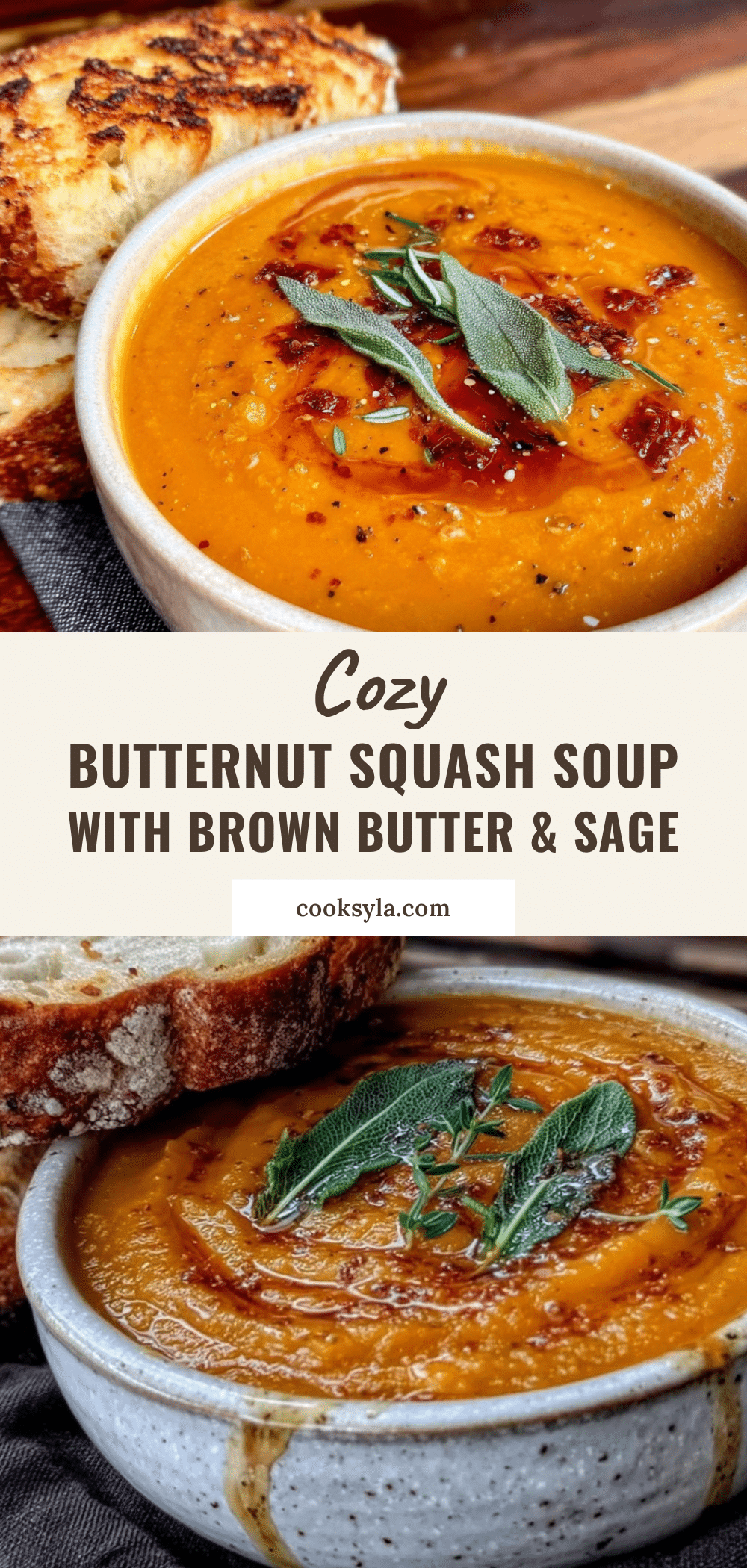
Cozy Butternut Squash Soup with Brown Butter Sage

This cozy butternut squash soup with brown butter and sage is the taste of autumn in a bowl. Roasted squash caramelized with maple syrup is blended into a velvety soup, then finished with nutty brown butter and crispy sage leaves for an unforgettable comfort dish.
- Prep Time: 15 minutes
- Cook Time: 30 minutes
- Total Time: 45 minutes
- Yield: 4 servings 1x
- Category: Soup
- Cuisine: American
Ingredients
- 1 medium butternut squash (about 2–3 pounds), peeled, seeded, and cubed into 1-inch pieces
- 1 tablespoon olive oil
- 1 tablespoon maple syrup
- 1 medium yellow onion, diced (about 1 cup)
- 3 cloves garlic, minced
- 4 cups vegetable broth, low sodium
- 1/2 cup heavy cream
- 1/2 teaspoon salt, plus more to taste
- 1/4 teaspoon black pepper, freshly ground
- 1/4 teaspoon nutmeg, freshly grated or pre-ground
- 4 tablespoons unsalted butter
- 10–12 fresh sage leaves, plus extra for garnish
- Flaky sea salt, for finishing
Instructions
- Preheat your oven to 400°F (200°C). Line a baking sheet with parchment paper. Peel the butternut squash, cut off the top and bottom, slice in half lengthwise, and scoop out the seeds. Cut the flesh into 1-inch cubes.
- Toss the cubed squash with 1 tablespoon olive oil, 1 tablespoon maple syrup, and a pinch of salt. Spread in a single layer on the baking sheet. Roast for 25-30 minutes, flipping halfway, until edges are caramelized and fork-tender.
- While the squash roasts, heat 1 tablespoon olive oil in a large pot over medium heat. Add the diced onion and cook for 5-6 minutes until translucent. Add the minced garlic and cook for 1 more minute.
- Add the roasted squash to the pot along with 4 cups vegetable broth. Bring to a boil, then reduce to a simmer. Cook for 10 minutes.
- Blend the soup until smooth using an immersion blender directly in the pot, or in batches in a regular blender (let cool slightly first).
- Stir in 1/2 cup heavy cream, 1/2 teaspoon salt, 1/4 teaspoon black pepper, and 1/4 teaspoon nutmeg. Taste and adjust seasoning. Keep warm on low heat.
- In a small skillet over medium heat, melt 4 tablespoons unsalted butter. Swirl occasionally. After 3-4 minutes, when the butter foams and turns golden with amber specks and smells nutty, immediately add the sage leaves. Cook for about 30 seconds until crisp, then remove from heat.
- Ladle the soup into bowls. Drizzle a spoonful of brown butter over each serving, top with 2-3 crispy sage leaves, and sprinkle with flaky sea salt. Serve immediately.
Notes
Don’t skip roasting the squash—it caramelizes the natural sugars for deeper flavor. Watch the brown butter carefully; it goes from perfect to burnt in about 30 seconds. Season in layers for best results. The soup can be made ahead (without cream and brown butter) up to 2 days in advance; flavors deepen overnight.
Nutrition
- Serving Size: 1 bowl (about 1.5 cu
- Calories: 320
- Sugar: 10
- Sodium: 582
- Fat: 22
- Saturated Fat: 12
- Carbohydrates: 28
- Fiber: 5
- Protein: 4
Keywords: butternut squash soup, brown butter sage, fall soup, cozy soup, vegetarian soup, gluten-free soup